

03 Feb The Camera and the Chemist, the Picselles and the Pies.
The Camera and the Chemist,
the Picselles and the Pies:

William first encountered photography at the county fair in 1860. A travelling photographer had wheeled his wagon over near the livestock pens, advertising 25 cents per portrait.
William asked if he and Margaret could pose together for 35 cents, with a few props added to the scene. The photographer agreed.
Margaret sat in a decorative chair, her arm up on the table with a plant. William was standing behind her. They kept completely still while the photographer readied the camera.
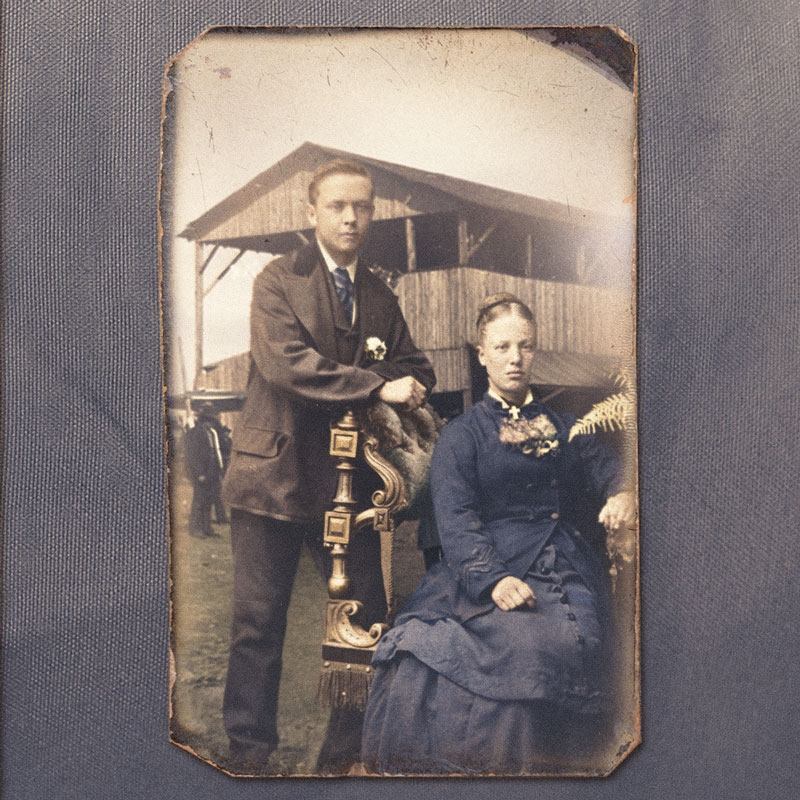
There was a bird in a cage to the left of the tripod, “Watch the birdie please,” the photographer then removed the lens cap for 2 seconds and then placed it back.
“Thank you, that should do nicely,” the photographer said. “I will return in ten minutes. In the meantime please browse my wife’s Jams and pickles while you wait.” He inserted a dark slide into the cassette and took the photo to his Wagon for processing.
Later, he emerged and walked over to William, producing a paper-framed copper plate bearing their image.
William was amazed – The image was clear and bright, drawn not by charcoal or brush, but by light itself. A deep silvery image on a piece of thin metal, “Astounding!” he said to the photographer, “It is magic. If you don’t mind, I have many questions on how this is done?”
The photographer asked William to return at the end of the day, agreeing to show him how it worked.
William brought him a bushel of his fancy apples and some cider as payment for his time. They discussed how a camera works and the chemicals required to process the plates. William listened carefully, writing everything down, imagining how he could perform the same miracle with what he had around the farm.
The photographer liked William’s enthusiasm and suggested that his apple cider might serve as a developing agent if he were unable to find the right chemistry in his area. William thanked him for the tip.
The Camera and the Chemist
It took William a year to save enough for his first camera, a Tailboard field camera that he picked up from town. He treated it with the same care you’d give to a living thing.
His focus was now on producing Photographic Plates. The metal was easily sourced from the blacksmith, but the silver would be more difficult to obtain.
Henry, his friend up the road, told him to talk to the chemist at the apothecary. His name was Alistair Fenwick, and he would know how to produce Silver Nitrate, the reactive substance used to form the image.
“Lunar Caustic should do the trick,” Mr. Fenwick said, “It is a topical antiseptic, used to remove warts and cauterize wounds… dissolve it in water, and you have a Silver Nitrate solution.”
“This is great! thank you,” William was very pleased.
“Be careful though, it is caustic, meaning it is corrosive. You will need to find a way to adhere the silver to the plate and stabilize it,” Alistair said, “something viscous, in my estimation.”
William thought for a moment, “Perhaps egg whites?” He blurted out.
“Yes, a fine suggestion. You have good intuition for a young man.”
William smiled and set off for home to begin testing.
He had a few chickens on the farm, and so he cracked a dozen eggs into a bowl, separating the yolks. After mixing in the silver solution, he poured it over the metal plate he had. Letting it dry. It stabilized nicely, forming a resilient emulsion that stuck to the metal.
Because the plates were light-sensitive and the silver solution was slightly toxic, William would work at night in the barn. He would work in the darkest areas, away from windows where the moonlight would shine in.
William’s first attempts were disastrous. Plates got clouded, images vanished, silver stained and burned his fingers.
More than once, Margaret found him late at night, in the barn, staring into a pan of spoiled apple cider and blackened plates. She gave him some encouraging words, brought him water and soap to wash his hands, and reminded him that it would take time. He finally discovered that a mixture of baking soda and salt would ‘fix’ the plate after developing, stabilizing the image.
This was the key to mastering the process.
The Picselles and the Pies
After a year, William decided to build a Studio in the barn to hone his new craft. He would work out there all year long, even in winter, stoking a fireplace to keep warm.
Of course, Apple cider was necessary for his photography, but it was also a healthy drink for winter. At first, he produced enough for the studio and for Margaret and himself, but eventually he expanded production in order to sell in the local market as well.
This brought in extra income, enough to build a large kitchen in the barn. This eventually grew into a small Bakery, allowing him and Margaret to bake & sell apple pies, further helping with the finances.
In each pie box, William included a sample of his photography. People enjoyed the surprise of these charming little TinTypes, which he called “Picselles,” a fun wordplay combining ‘Pic’ from picture and ‘cell,’ suggesting a small unit.
These small images were photos of Apple Blossoms, the Pyle Orchard, and sometimes of William and Margaret standing together between the rows of their trees. Eventually, even customers made it into the photos, which proved to be a priceless bit of marketing as people wanted to ‘make it into the box.’
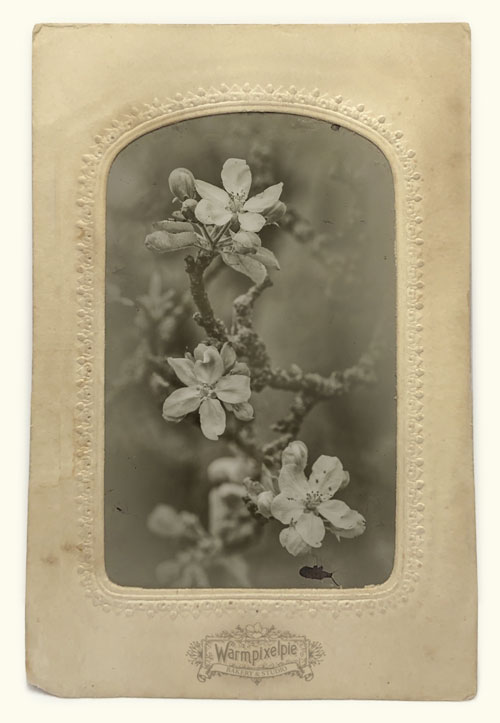
Overall, the pies brought the community together, and the picselles became collectible items unto themselves, ones everyone cherished. At its height, the Pyle Orchard was the pride of the community, making William and Margaret very proud.
Strangely, the Bakery was never formally named, but was known as “William’s Picselles and Pies”. This stuck for a while until it evolved into “Warm Piscelles and Pies”. Warm because of the connected feeling the community had to itself and the farm, but also because the pies were always freshly out of the oven.
And then, as with all things that become familiar and cultural, the name shortened further, this time into its last form – “Warmpixelpie.”
~CJ~